
Ever been texting a friend and they suddenly say “TMI!”, leaving you scratching your head? 📱 Understanding online abbreviations like TMI is essential in today’s fast-paced digital conversations.
In this comprehensive guide, we’ll explore what TMI meaning in text truly is, its origins, real-life examples, and why knowing this can save you from awkward moments.
What Does TMI Stand For in Text? 📖
TMI is an abbreviation for “Too Much Information“. It’s used in texting, social media, and online chats to signal that someone has shared overly personal, graphic, or unnecessary details. Think of it as a polite (or sometimes sarcastic) way of saying, “Whoa, that’s more than I needed to know!” 😳
Examples of TMI in Everyday Texts
- Friend: “I sneezed 5 times in a row and almost coughed up my lunch!”
You: “TMI 😅” - Colleague: “I got that pimple right on my nose and it’s huge.”
You: “Yikes, TMI!”
The Origin of TMI 🕰️
The term TMI originated in American English during the late 20th century, mostly in informal settings. It gained popularity in the 1980s and 1990s as a quick way to respond to oversharing without being rude. Today, it’s a staple in text messaging, forums, and social media platforms. 🌐
Why People Use TMI in Texts 📲
TMI serves multiple purposes in digital conversations:
- Boundaries: Politely signal when content is too personal.
- Humor: React sarcastically to oversharing.
- Awareness: Avoid uncomfortable details or oversharing in group chats.
Psychology Behind Saying TMI
Humans naturally avoid discomfort. Sharing too much personal information can trigger empathy overload. Using TMI in text acts as a social cue that sets conversational boundaries without confrontation. 🧠
How to Properly Respond with TMI ✅
Using TMI effectively keeps chats light and fun. Here are some tips:
- Use emojis to soften the response: “TMI 😅” or “TMI 🤭”
- Follow with a humorous comment: “TMI… I didn’t need to picture that!”
- Respect context: Only use it when someone overshares, not to shut down important conversations.
Common Scenarios Where TMI Appears
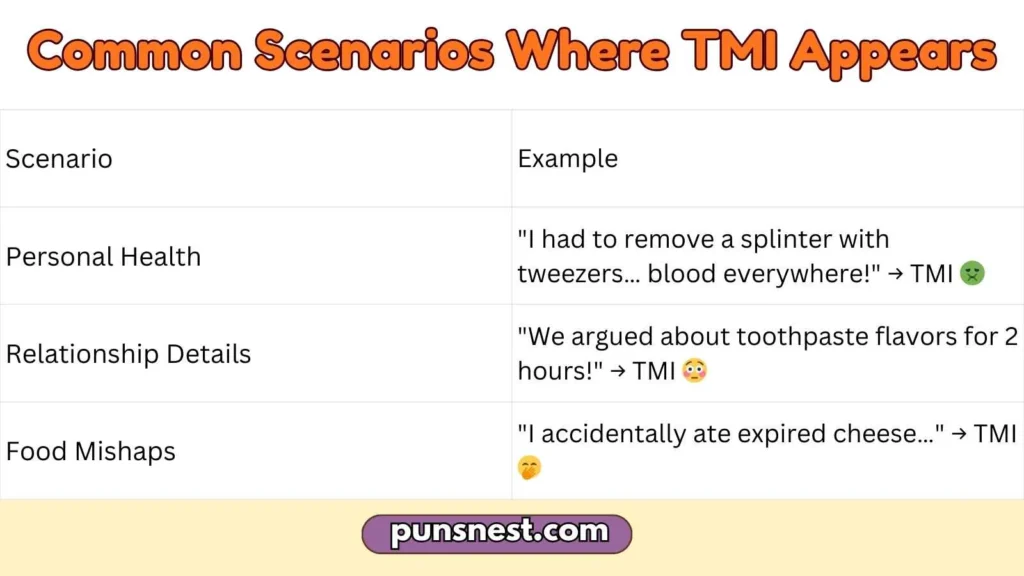
| Scenario | Example |
|---|---|
| Personal Health | “I had to remove a splinter with tweezers… blood everywhere!” → TMI 🤢 |
| Relationship Details | “We argued about toothpaste flavors for 2 hours!” → TMI 😳 |
| Food Mishaps | “I accidentally ate expired cheese…” → TMI 🤭 |
Differences Between TMI, FYI, and BTW 🆚
Understanding online abbreviations helps you communicate clearly:
- TMI: Too Much Information – oversharing alert 🚨
- FYI: For Your Information – neutral or helpful info 📬
- BTW: By The Way – adding info casually 🗨️
Top 10 Synonyms and Related Terms for TMI
Some online alternatives include:
- Oversharing
- Too personal
- Intimate details
- NSFW content
- Graphic info
- Private matters
- Unnecessary info
- Excessive sharing
- Overload
- Way too much
How TMI Affects Social Media Etiquette 🌐
Sharing TMI can impact online interactions in multiple ways:
- Reduces engagement: Followers may scroll past uncomfortable posts.
- Signals authenticity: Honest oversharing can also build trust with friends or followers.
- Creates boundaries: Knowing when to post sensitive content is crucial.
Examples of TMI in Pop Culture 📺
From sitcoms to memes, TMI is everywhere:
- In Friends (1994–2004), Ross often reacts with TMI when others overshare awkward stories.
- Social media memes often caption shocking or oversharing texts with “TMI!” for comedic effect.
Tips to Avoid Being TMI in Texts ✨
- Think before sending personal details.
- Keep messages concise and relevant.
- Use humor or emojis to lighten sensitive info.
- Check if the audience wants to know details.
- Separate private info into direct messages, not group chats.
Fun Facts About TMI 🎉
- The abbreviation is often pronounced letter by letter: “T-M-I.”
- Some texting apps automatically highlight TMI words in group chats as warnings.
- TMI can be used ironically when nothing personal was shared at all.
When TMI Can Be Positive 💡
Though often seen as a warning, TMI can strengthen relationships:
- Shows honesty and trust in sharing personal experiences.
- Builds humor and relatability in conversations.
- Encourages empathy and understanding among friends.
Using TMI Across Different Platforms 📱💻
TMI usage varies slightly by platform:
- Texting: Quick, casual response 😅
- Instagram/TikTok: Comment reaction or caption for memes 📸
- Facebook/Forums: Can be used humorously or as a soft warning ⚠️
Advanced Tips for Digital Communication Experts 🧠
Pro communicators know how to manage TMI strategically:
- Balance transparency with appropriateness.
- Observe cultural differences; TMI tolerance varies globally 🌎
- Use TMI reactions to improve engagement and humor.
Real-Life Examples of TMI Situations
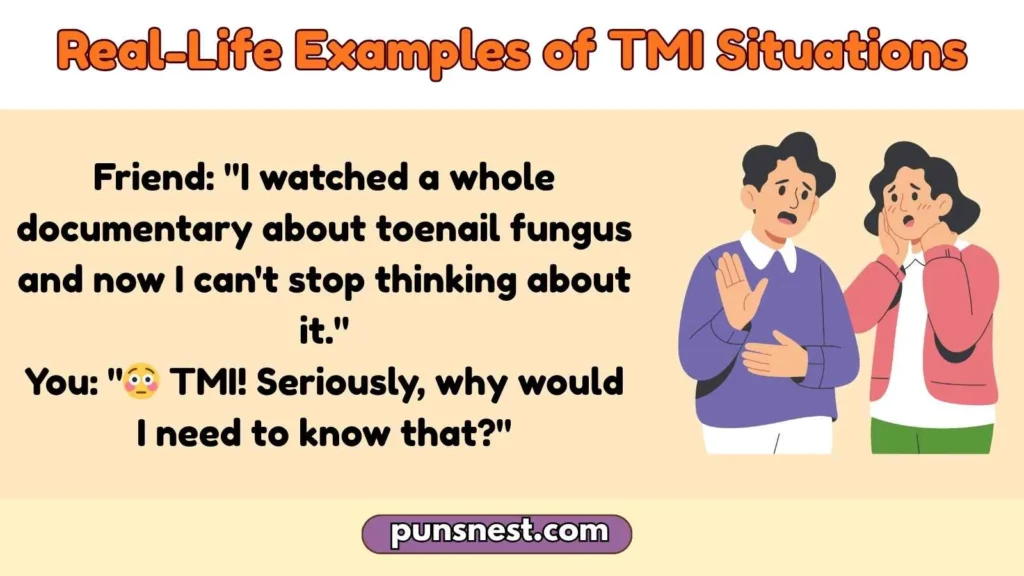
Here are some relatable oversharing scenarios:
Friend: “I watched a whole documentary about toenail fungus and now I can’t stop thinking about it.”
You: “😳 TMI! Seriously, why would I need to know that?
Partner: “I dreamt I was eating soup with my ex last night.”
You: “TMI 🤯 Can we not talk about dreams?”
FAQs
1. Is TMI rude to use?
Not necessarily. It depends on context. Often, TMI is playful, but tone and audience matter.
2. Can TMI be used professionally?
Rarely. In professional communication, oversharing should be avoided, so TMI is usually unnecessary.
3. What is the opposite of TMI?
The opposite could be “FYI” (For Your Information), providing only relevant or necessary details.
4. How do I know if something is TMI?
Ask yourself: Would my audience want this detail? If the answer is no, it’s probably TMI.
5. Are there emojis that go well with TMI?
Yes! Common ones include 😅, 🤭, 😳, and 🤯 to signal humor or surprise.
Conclusion:
Understanding TMI meaning in text is crucial for smooth digital communication.
Whether for humor, boundary-setting, or social etiquette, knowing when to use or react to TMI keeps conversations engaging and respectful.
Remember: not every detail needs to be shared, but when handled correctly, TMI can make interactions fun and memorable. 💬

I created PunsNest to explore the real meanings behind words in a simple and relatable way. I enjoy breaking down complex terms into clear, easy explanations that anyone can understand. Through my writing, I aim to make every meaning feel practical, authentic, and genuinely helpful.